
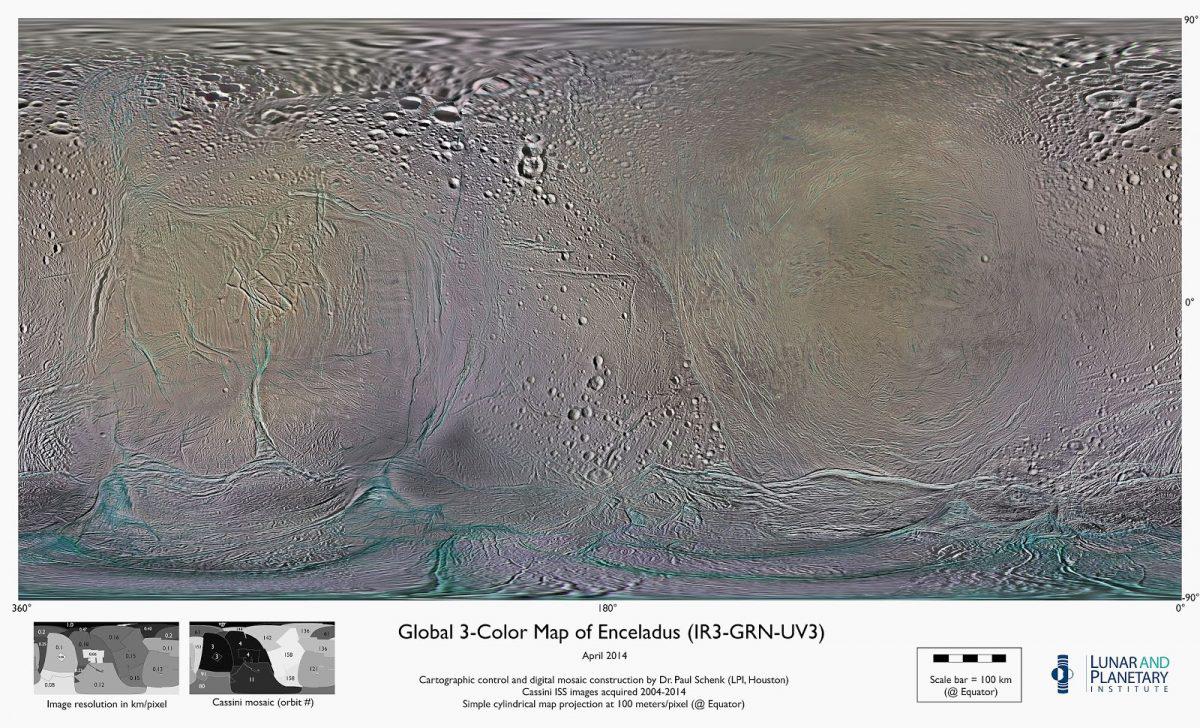
Enceladus is one of the major inner satellites of Saturn along with Dione, Tethys, and Mimas. It orbits at 238,000 km from Saturn’s center and 180,000 km from its cloud tops, between the orbits of Mimas and Tethys.
Moreover Does it rain on Titan? Titan’s rains, when they fall, appear to have a monsoon-like effect on the surface, with downpours that shape alluvial fans. Alluvial fans are roughly triangular features made of sediments deposited by flowing water or even glaciers. These landform features are seen on places such as Titan, Earth and Mars.
Could Europa have life? The type of life that might inhabit Europa likely would not be powered by photosynthesis – but by chemical reactions. Europa’s surface is blasted by radiation from Jupiter. That’s a bad thing for life on the surface – it couldn’t survive. But the radiation may create fuel for life in an ocean below the surface.
Herein How was Enceladus created? The moon creates a ring of its own as it orbits Saturn—its spray of icy particles spreads out into the space around its orbit, circling the planet to form Saturn’s E ring. Enceladus is named after a giant in Greek mythology.
Is Europa bigger than Earth?
So while Europa is only one-fourth the diameter of Earth, its ocean may contain twice as much water as all of Earth’s oceans combined. Europa’s vast and unfathomably deep ocean is widely considered the most promising place to look for life beyond Earth.
How long is a day in Titan? The day cycle on Titan lasts 15.9 Earth days, which is how long it takes Titan to orbit Saturn.
Is there sunlight on Titan? Titan has a radius of about 1,600 miles (2,575 kilometers), and is nearly 50 percent wider than Earth’s moon. … One AU is the distance from Earth to the Sun. Light from the Sun takes about 80 minutes to reach Titan; because of the distance, sunlight is about 100 times fainter at Saturn and Titan than at Earth.
Is there life on Enceladus? Enceladus is a small icy moon with jets or geysers of water erupting from its surface that might be connected to active hydrothermal vents at its subsurface water ocean floor, where the moon’s ocean meets the underlying rock, a prime habitat for life.
What planet is Uranus?
Uranus is the seventh planet from the Sun, and has the third-largest diameter in our solar system. It was the first planet found with the aid of a telescope, Uranus was discovered in 1781 by astronomer William Herschel, although he originally thought it was either a comet or a star.
Is Enceladus habitable? From a distance, Saturn’s moon Enceladus is nothing special. … That first close flyby revealed an unexpected world with a subsurface ocean and plumes of water ice and vapor erupting from the moon’s south polar region, making it one of the most potentially habitable places of the Solar System.
Who is the giant in the lost hero?
Enceladus appears on Piper’s dagger, Katoptris. Enceladus is 30-foot tall giant, only shorter than Polybotes, Alcyoneus, and Porphyrion.
What did Voyager 2 discover about Enceladus? Voyager showed that Enceladus sits in the thickest part of the E ring, suggesting that this tiny moon was somehow spewing material into space and building it up over time.
Is Titan or Europa better for life?
Europa is more likely to have life. Europa has liquid water, and as far as we know, water is needed for life. The oceans on Europa are very deep and covered in ice, but there are likely thermal vents where life could evolve. Titan has liquid methane on the surface.
Can you walk on Pluto?
Pluto is only about two-thirds as wide as Earth’s moon and has about the same surface area as Russia. … As a comparison, on Earth, you could blot out the full moon with your thumb if you held out your arm, but it would take almost your entire fist to block Charon while standing on Pluto, Stern said.
How hot does Titan get? Although it moves in latitude, the maximum measured temperature on Titan remains around -292 degrees Fahrenheit (-179.6 degrees Celsius, 93.6 Kelvin), with a minimum temperature at the winter pole only 6 degrees Fahrenheit (3.5 degrees Celsius or Kelvin) colder.
Can you breathe on Titan? But there isn’t any oxygen to breathe, so you are going to suffocate. The temperature on the surface is a very chilly −179.2 °C, so you can’t just stand around in street clothes. In fact, your lungs would freeze trying to breathe the nitrogen atmosphere. And Titan’s surface would be completely dark.
How big is Titan vs Earth?
Size.
With a mean radius of 2576 ± 2 km and a mass of 1.345 × 10²³ kg, Titan is 0.404 the size of Earth (or 1.480 Moons) and 0.0225 times as massive (1.829 Moons). Its orbit has a minor eccentricity of 0.0288, and its orbital plane is inclined 0.348 degrees relative to Saturn’s equator.
How long would it take to get to Titan? When will the mission launch how long will it take to get to Titan? This mission would last about 14 years. It would take roughly seven years to get there, and then the same to get back, though well-timed gravity-assists either on the way there or back could reduce the total flight time to just 10 years.
How big is Titan vs Mars?
Titan has a diameter of 5151 km and is the second largest moon of the Solar System after Jupiter’s Ganymede (5270 km of diameter). It’s actually larger than one of our planets, Mercury (4880 km) and not so much smaller than Mars (6780 km).
Does life exist on Saturn? Saturn’s environment is not conducive to life as we know it. … While planet Saturn is an unlikely place for living things to take hold, the same is not true of some of its many moons. Satellites like Enceladus and Titan, home to internal oceans, could possibly support life.
Is there life in Pluto?
To be fair, there is virtually no chance that Pluto has life living on its surface. … Basically, when Pluto is at perihelion, the atmosphere freezes solid; when it is at aphelion, the surface temperature increases, causing the ices to sublimate. As such, there is simply no way life could survive on the surface of Pluto.
What is Rhea made of? Rhea is an icy body with a density of about 1.236 g/cm3. This low density indicates that it is made of ~25% rock (density ~3.25 g/cm3) and ~75% water ice (density ~0.93 g/cm3). Although Rhea is the ninth-largest moon, it is only the tenth-most-massive moon.
Don’t forget to share this post with BF 🔥 !


